PANS and PANDAS are diagnoses that have been around for decades, supported by well-decorated scientists, researchers, and clinicians who have dedicated their careers to understanding it—teams at Stanford Medicine, Mass General, and researchers at Columbia University among them.
The idea that viruses, bacteria, and post-infectious inflammation can trigger neuropsychiatric symptoms is not new.
Rheumatic fever has long been known to cause chorea, mood changes, and OCD. PANS/PANDAS appears to function differently—not involving the heart the way rheumatic fever does, but still impacting the immune system and basal ganglia part of the brain.
Research on the immune system’s relation to the brain asks us to rethink foundational concepts of modern medicine and psychiatry, and that can be understandably challenging.
While we are beginning to understand this better, there is exciting research happening in real time to continue to develop biomarkers and medical treatments for these pediatric conditions.
These diagnoses that are incredibly complex for physicians to identify and manage, and the children who suffer from it are very ill. The resources are scattered, and families and medical providers alike are left scrambling as they try to piece together treatment. Locally and systemically, care is disjointed.
Here is what I believe: the stakes are simply too high to wait to address the needs of these families and children, and we need to act now with the resources that we do have to better support these families with the evidence-based recommendations that do exist in the medical field.
When there is a need but no safe landing place, we can’t sit back—we have to build what’s missing ourselves in this community.
Bridging the Gap for Families Navigating PANS/PANDAS
To address this need of acutely suffering children and families, I have expanded my practice to offer consulting services for PANS/PANDAS and a CE training for licensed psychologists and mental health professionals.
My goal is to serve as a credible, evidence-based resource in a landscape that has historically felt barren for families seeking assessment and guidance for OCD symptoms associated with PANS/PANDAS. I have extensively reviewed the scientific literature on this topic and work strictly within my scope as a licensed mental health counselor, rigorously trained through the International OCD Foundation’s world-renowned BTTI program. PANS/PANDAS is recognized by IOCDF as a subset of OCD caused by immune dysfunction.
A Note on Evidence-Based Care
I am a clinician who values both open-minded, creative thinking and firmly grounded in evidence-based practice.
One of the challenges in the PANS/PANDAS landscape is the presence of unlicensed providers or other professionals who operate outside their scope or recommend treatments that are unsafe or unsupported by research.
When working with children—and overwhelmed, worried parents—it is essential to stay measured. We must hold space for the possibility of complex medical or psychiatric causes without overpromising or endorsing interventions that have not been rigorously evaluated.
My goal is to serve as a steady, trustworthy guide in a landscape where families are often presented with confusing or concerning recommendations. I collaborate closely with physicians to support families as they make decisions with credible medical doctors that are guided by ethics; credible scientific research; and always weigh risks and benefits thoughtfully.
My commitment is to provide support that is responsible, ethical, and aligned with best-practice standards in today’s medicine.
Not every case will be PANS/PANDAS, and when it isn’t, I will support clients with appropriate, evidence-based care for OCD, anxiety, or other symptoms using established standards of mental health practice.
PANS/PANDAS Interdisciplinary Evaluation – Physician Referral (NYS Only)
Like many complex medical and mental health conditions, PANS/PANDAS is best understood through an interdisciplinary approach that includes both medical and mental health perspectives.
This consultation service is designed for pediatricians and other physicians who suspect PANS/PANDAS and are seeking a formal mental health evaluation to help differentiate between more traditional OCD presentations and OCD symptoms associated with PANS/PANDAS. This distinction is nuanced and requires a clinician familiar with the unique ways these conditions can present in children.
What the Evaluation Includes:
A 90-minute evaluation involving both the child and their caregivers
When warranted, administration of the CY-BOCS, the internationally recognized gold-standard assessment for OCD
A structured PANS/PANDAS-informed assessment guided by current research, clinical recommendations, and validated tools
A comprehensive review of the child’s psychological, social, developmental, and medical history
Following the Evaluation:
A comprehensive written report is provided to the referring physician and other members of the care team
Recommendations for next steps and care coordination (within my scope of practice as a licensed mental health professional)
Referrals to trusted colleagues for further evaluation and treatment, when indicated
Important Scope of Practice Note
This assessment does not result in a formal PANS diagnosis. Mental health counselors do not diagnose PANS, as it is a clinical diagnosis of exclusion that requires medical rule-outs completed by a physician. This evaluation is intended to complement the medical assessment and help determine whether further medical intervention for PANS/PANDAS may be appropriate.
Referrals and Fees
Physicians or families may refer families directly by contacting therapy@barbshepardcounseling.com
Fee for diagnostic consultation only (one-time session):
$400 for the diagnostic consultation and written report (includes copy of PDF Parent Guide)
Fees for parents/child seeking ongoing care:
$400 initial session (includes diagnostic consultation, written report, and copy of PDF Parent Guide)
200 per subsequent session
Clinical & School Consultation
I provide consultation for therapists, school-based mental health professionals, and multidisciplinary teams working with complex cases, including children with suspected or confirmed PANS/PANDAS. Services include assessment guidance, differential diagnosis, treatment planning, school advocacy, and ongoing support for evidence-based care of OCD, anxiety, and related symptoms.
Resources Provided
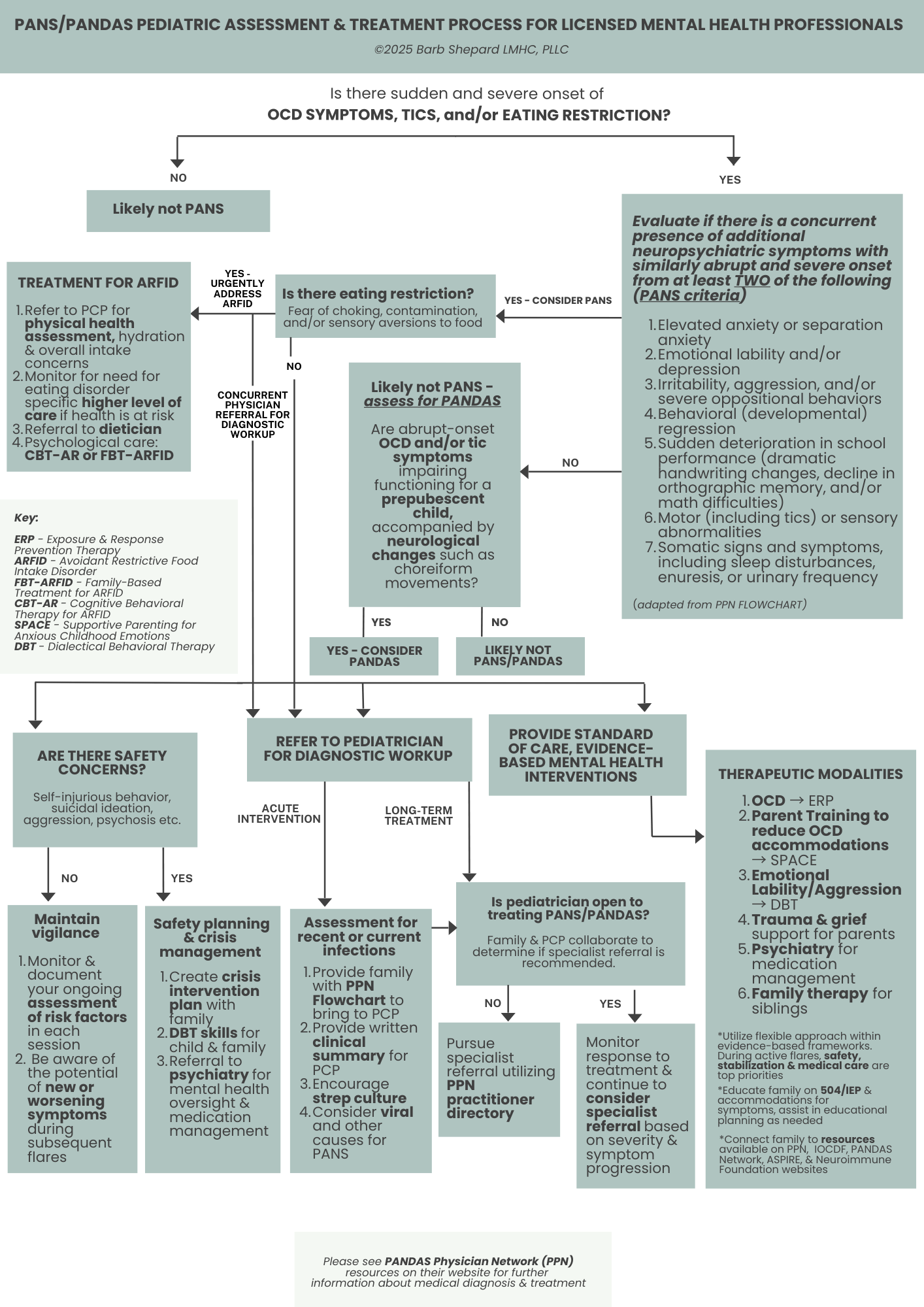
All consultations include practitioner tools, including a PANS/PANDAS Assessment & Treatment flowchart and an Intake & Referral Guide, covering symptom assessment, safety, crisis planning, interventions, and school collaboration.
School Support
I consult with school teams via Zoom or in-person, including IEP/504 planning. Guidance includes understanding symptom-driven behavior, practical accommodations, and managing symptom variability during flares.
Fees
$200/hr individual consultation (Zoom or in-person)
$300/hr team training (Zoom or in-person)
$150/30-minute follow-ups
On-Demand Webinar
Understanding PANS/PANDAS: A Research-Informed Clinical Overview
For those looking for a deeper dive than the PDF guide above, this 1 hour 50 minute on-demand webinar provides a comprehensive, research-informed overview of PANS/PANDAS through the lens of a Licensed Mental Health Counselor (LMHC). PANS/PANDAS are diagnoses that sit at the intersection of medical care and psychological care. This webinar focuses on understanding the literature and clinical consensus guidelines on the treatment of these diagnoses.
What We Cover
History and evolution of PANS/PANDAS as diagnoses
Diagnostic symptoms and differential diagnosis (PANS OCD vs. non-PANS OCD)
In-depth overview of biology, immune dysfunction, and neuroinflammation
Review of medical and behavioral health literature and clinical consensus recommendations
School accommodations and classroom support
Caregiver burden and family impact
Current and ongoing research, including biomarker studies
Who This is For
Mental health professionals, physicians, school staff, occupational therapists, parents, caregivers, or anyone else seeking a foundational understanding of PANS/PANDAS.
Includes: 119-slide PDF and on-demand access to Webinar via Zoom platform.
Cost: $99 — watch at your own pace.
FREE Resources for Therapists
I have developed a series of PDF guides designed to support licensed mental health clinicians in navigating assessment, diagnostic considerations, and referral pathways related to PANS/PANDAS. These resources are intended to bridge gaps in clinical training by offering practical, structured tools that can be integrated into everyday practice.
The first guide, PANS/PANDAS Intake, Assessment, and Referral Process for Licensed Mental Health Clinicians, provides an expanded framework for the biopsychosocial assessment. It helps clinicians screen for possible PANS/PANDAS presentations, recognize red flags, and determine appropriate next steps in treatment planning and referral.
This guide is complemented by a concise decision-tree style mental health flowchart that visually summarizes the intake and assessment process. The flowchart is designed to support clinical decision-making by clearly outlining pathways based on presenting symptoms, assessment findings, and levels of concern.
These materials are intended to be living documents. They will be continually updated as new research and clinical guidance emerge within the mental health and medical fields. I welcome collaboration with other clinicians engaged in this work, as collective knowledge and shared expertise strengthen the quality of care. These guides represent a good-faith effort to synthesize a large and complex body of information into a practical, user-friendly format that clinicians can readily apply in their work.
Community Engagement

On October 9, 2025, I organized Syracuse’s first-ever participation in World PANS/PANDAS Awareness Day, joining more than 220 landmarks across the globe. The National Grid building lit up in support of children and families affected by PANS/PANDAS, and our community showed up—educators, pediatric and mental health providers, parents, and children gathered together for a powerful moment of visibility, connection, and advocacy.
Standing in that space, hearing families share their stories of the devastating and isolating impact of PANS, it became clear just how urgent the need is in Central New York for informed providers willing to pick up the torch for these families. The relief people expressed at simply being seen solidified this: families cannot do this alone, and our systems have a long way to go in addressing these needs.
This is why I expanded my practice to include specialized PANS/PANDAS consulting services—to meet the community’s growing need for education and collaboration that extends beyond the walls of the therapy room. To learn more about symptoms of PANS/PANDAS, click here.
Ready to get started?
Whether you’re a parent seeking guidance, a therapist navigating a complex case, or a school aiming to better support students, I’m here to help. My coaching and consulting services are designed to provide clarity, resources, and practical strategies so families and professionals can confidently navigate PANS/PANDAS. As a parent who has personally navigated the complexities of the medical system for my own family, I deeply understand the challenges families face when trying to find appropriate care for their child. I operate with a heart-forward approach and am truly here to help in any way I can.
Reach out today to schedule a session or learn more: therapy@barbshepardcounseling.com.
 Barb Shepard, LMHC, PLLC