Therapy & consulting for OCD, ANxiety & PANS/PANDAS
You’re here because anxiety or OCD has made life smaller than it should be.
You’ve tried therapy before. You’ve read the books, downloaded the apps, practiced the coping skills, tried to “get rid of” the thoughts, taken the deep breaths, and told yourself a thousand times, “I should be able to handle this by now.”
And yet, you’re still feeling stuck.
You still find yourself second-guessing decisions, replaying conversations, checking and rechecking, seeking reassurance, or bracing for the next bad thing that might happen.
You’re lying awake at night trying to solve problems that don’t have answers. Or, you might be a parent feeling heartbroken as you see child struggling and wondering what else you can possibly to help them. You’re exhausted from carrying the weight of anxiety every single day and frustrated that all of your effort hasn’t translated into relief.
If trying harder was the answer, you’d feel better by now.
Here’s the good news: anxiety and OCD are entirely treatable with the right support.
Finding the right therapist matters. Contrary to what TikTok might lead you to believe with all kinds of “hacks for anxiety,” these diagnoses truly do require specialized treatment with a licensed professional working who understands the nuances of anxiety and OCD. Just because you’ve felt this way for as long as you can remember does not mean you have to keep living this way forever.
There is a big, beautiful life waiting outside the cloud of fear you’ve been living under. With the right support, the right tools, and a willingness to do the work, it is absolutely possible to move toward that life.
By the time many people find me, anxiety or OCD has been stealing pieces of their life for years.
For children, anxiety and OCD might show up as bedtime battles, repeated reassurance-seeking, anger around transitions, or meltdowns over things that seem small from the outside but feel enormous inside their little bodies. What many people miss is that these behaviors are rarely about being difficult. More often, they’re a sign that a child is struggling with overwhelming fear or intrusive thoughts and doesn’t yet have the tools to manage it.
As children grow into teenagers, anxiety and OCD evolve. What once looked like “just right” rituals may become perfectionism in academics, fear of throwing up, or a constant worry that everyone is mad at them Parents often tell me, “It’s like they’re carrying the weight of the world on their shoulders, and they won’t talk to us anymore.”
For adults, anxiety and OCD can appear quieter to the outside world, but not easier on the inside. You may look successful, capable, and high-functioning to those around you while privately struggling with relentless doubt, rumination, health anxiety, or the constant feeling that something terrible is just around the corner. You replay conversations, question your decisions, seek reassurance, Google symptoms, and lie awake at night trying to solve problems that haven’t happened yet. The exhausting part is that most people around you have no idea how hard you’re working just to get through the day.
OCD and anxiety are family affairs, and good treatment includes the entire system.
When anxiety, OCD, or other complex mental health challenges affect a child, the impact extends far beyond the child alone. Parents find themselves carrying the emotional weight of their child’s struggles while trying to keep up with work, relationships, responsibilities, and the everyday demands of life. It’s hard to fully relax when you’re constantly worried about how your child is doing, what might happen next, or whether you’re making the right decisions.
Many of the parents I work with have become accidental experts in things they never expected to learn about. They’ve sat through appointments, researched treatments late into the night, advocated at school meetings, navigated insurance battles, coordinated care between providers, and spent countless hours trying to figure out how to help their child.
That’s why my work isn’t just about helping the individual who is struggling. It’s about helping the entire family better understand what’s happening, feel less alone, and develop practical strategies that actually move everyone forward.
I specialize in helping children, teens, adults, and families navigate anxiety, OCD & PANS/PANDAS using evidence-based treatment.
Many of the people who find their way to my office are feeling exhausted, discouraged, and wondering if they can even be helped. They’ve tried countless strategies, invested significant time and energy searching for answers, and often worry that things will never get better.
What I’ve learned in my years of doing this work is that people don’t get their lives back because they finally found the right breathing exercise. They get their lives back when they work with a therapist who does this work day-in and day-out, knows all of OCD’s tricks by heart, and keeps up-to-date on evidence-based interventions (there’s no “winging it” here!)
One of the greatest privileges of my work is watching people discover that they are capable of so much more than anxiety and OCD have led them to believe.
If you’re willing to show up consistently, practice new skills between sessions, take meaningful risks, and do the work—you CAN recover. I’ll be right there with you every step of the way as your biggest cheerleader. I’ll teach you, support you, encourage you, challenge you, and help empower you to get outside of your comfort zone so that OCD and anxiety are no longer calling the shots.
You CAN feel better, and I’m going to help you get there.
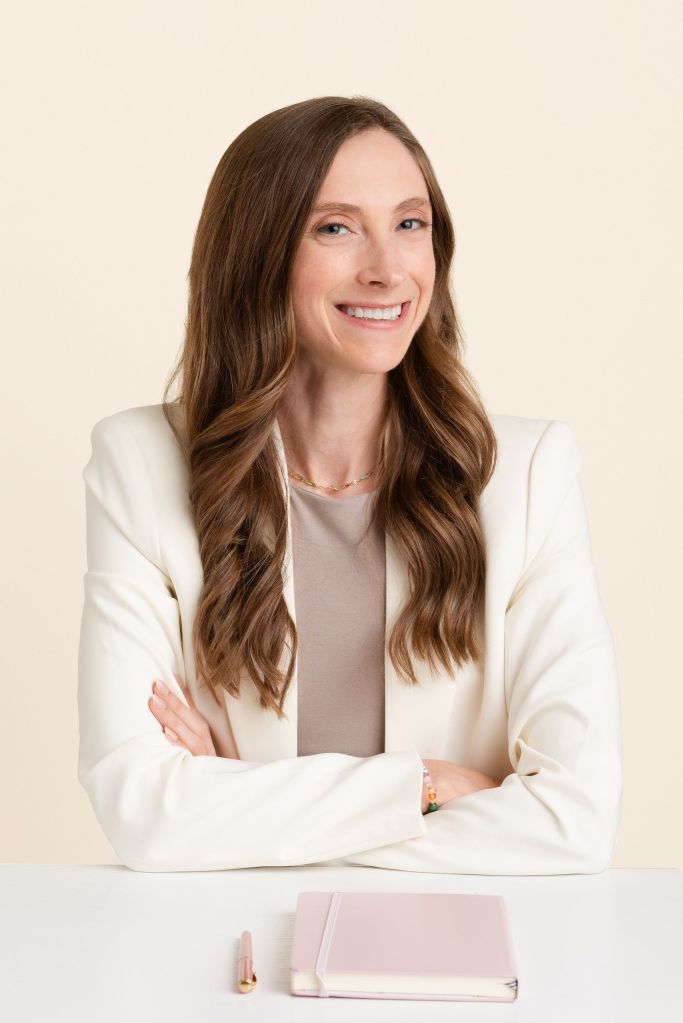
Hi, I’m Barb.
I’m a Licensed Mental Health Counselor who has been working with children, teens, adults, and families since 2010. I specialize in anxiety, OCD, and related disorders. I care deeply about helping people understand what they’re facing and what actually works.
I have a particular passion for working with parents who are navigating PANS/PANDAS, and complex medical or mental health challenges in their children. These parents are often carrying far more than anyone realizes. They’re advocating, researching, coordinating care, attending appointments, communicating with schools, and doing everything they can to help their child while trying to hold the rest of life together.
Whether you’re seeking ongoing therapy, looking for diagnostic clarity for your child, or searching for professional consultation, there are several ways to work with me. If you aren’t sure which route to go, send me an email at therapy@barbshepardcounseling.com
Become a Therapy Client (NYS Only)
If you’re interested in ongoing therapy for anxiety, OCD, phobias, PANS/PANDAS-related mental health concerns, or family support services related to the above concerns, please submit a therapy inquiry using the form below. I make every effort to respond to all inquiries within two business days. If my practice is currently full, I’m happy to provide referrals to other qualified providers whenever possible. Before reaching out, I encourage you to review my FAQ page for information about services, fees, and what to expect.
For parents seeking expert guidance regarding a child’s OCD, anxiety, school refusal, intrusive thoughts, reassurance-seeking, phobias, panic, ARFID, or other anxiety-related symptoms—including situations where there may be concern for neuroimmune involvement.
This consultation is ideal for families who are looking for a specialized pediatric OCD and anxiety assessment with a written report outlining diagnostic impressions, evidence-based treatment recommendations, guidance regarding Exposure and Response Prevention (ERP), and recommendations for appropriate referrals when indicated.
In addition to evaluating more traditional presentations of OCD and anxiety, this consultation includes screening for mental health red flags that may warrant further medical evaluation. This can be particularly helpful when a child’s physician has raised the possibility of PANS/PANDAS and would like a comprehensive mental health assessment to help determine whether the presentation appears more consistent with primary OCD or whether there are features that may warrant further discussion with the child’s medical team. (Not medical advice or diagnosis of PANS/PANDAS).
To learn more about how PANS/PANDAS can differ from more traditional presentations of OCD, the International OCD Foundation provides an excellent overview here:Differential Diagnosis: OCD vs. PANS
Whether you’re newly recognizing symptoms or have already met with multiple providers and still feel uncertain about the path forward, this consultation is designed to provide clarity, evidence-based recommendations, and a roadmap for next steps.
Clinician Consultation
For licensed mental health professionals seeking consultation on OCD, anxiety disorders, ERP implementation, ARFID, school refusal, family accommodation, suspected neuroimmune presentations, and differential diagnosis.
Bring a specific case, treatment challenge, diagnostic question, or concern related to OCD, anxiety, and related disorders. My consultation style is collaborative, practical, and focused on helping you leave with actionable recommendations that can be immediately integrated into your clinical work.
Consultations may include case conceptualization, treatment planning, ERP implementation, caregiver interventions, referral considerations, and guidance on recognizing mental health presentations that may warrant further medical evaluation for conditions such as PANS/PANDAS.
Clinicians who book a consultation also receive access to clinician-developed resources, including assessment guides, referral tools, and practical handouts designed to support treatment.
Individual and group consultation are available. Colleague cost-sharing is welcome.
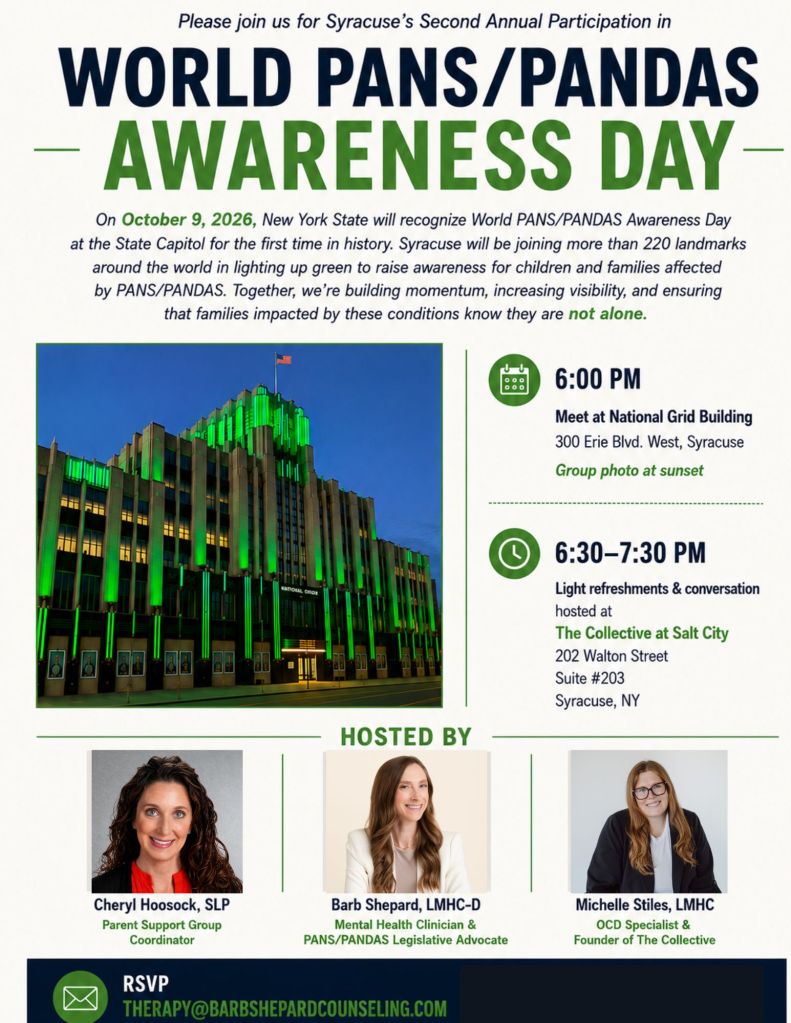
Get ready for World PANS/PANDAS Awareness Day in Syracuse, NY!
Syracuse is proud to participate in World PANS/PANDAS Awareness Day for the second year in a row!
As a volunteer with ASPIRE, I’m incredibly honored that we’ve once again partnered with National Grid to have the iconic National Grid Building illuminated green in recognition of children and families affected by PANS/PANDAS. To learn more about ASPIRE’s participation in the international campaign #lightup4PANS, visit their website here.
This event is about so much more than lighting a building. It’s about increasing awareness of a misunderstood condition, reducing stigma, connecting families who often feel isolated, and reminding every child and parent navigating this journey that they are not alone.
This year’s event is especially meaningful because it comes on the heels of an exciting milestone in our legislative advocacy efforts. Thanks to the incredible work of families and advocates across New York, a legislative resolution was passed in Albany officially recognizing World PANS/PANDAS Awareness Day at the New York State Capitol for the first time in state history. While there is still much work to be done, moments like these remind us that progress is happening, awareness is growing, and these children are finally beginning to be seen.
We hope you’ll join us on October 9 as Syracuse joins more than 220 landmarks around the world in shining green for PANS/PANDAS awareness.
Have you ever wondered what people mean when they talk about intrusive thoughts? If you’re like most people, you’ve had a strange thought pop in your head from time to time that TOTALLY freaked you out and was NOT something you actually felt…
You just received a referral for an OCD and anxiety therapist. As you sit in your car, you glance over a list of therapists, feeling overwhelmed and unsure where to start. You need support to understand what this diagnosis means for your child…
Did you know that abrupt onset of obsessive-compulsive disorder (OCD) or tics in children can have medical causes? Pediatric Autoimmune Neuropsychiatric Disorders Associated with Streptococcal Infections (PANDAS) and Pediatric Acute-onset Neuropsychiatric Syndrome (PANS) are post-infectious, immune-mediated conditions. In these disorders, the immune system…